
Foreword: The following article was written in 2023. It remains the only article ever published on my original blog.
I’m uploading it here, unedited, for posterity, but note that some formatting may be lost. While I may have worded things differently than my past self, I believe her point still stands.
Induced demand on the Information Superhighway
Dallas’ Katy Freeway has 26 lanes of asphalt, tar, and paint – the widest in the world. And yet, since its’ 2011 $2.8bil expansion to “ease congestion”, traffic has only gotten worse. What’s happening? Induced demand. The more infrastructure we build, the more people want to use it, the more clogged it gets. The solution? Efficiency – busses and trains carry hundreds of times more passengers without grinding to a halt. Cities like Tokyo, ten times larger than Dallas, run smoothly using this simple principle. Cool! An easy solution!! So why, then, is the modern web, our Information Superhighway, such a bloated mess?
That’s not hyperbole. It’s a fact. Our modern internet should be blazingly fast – we’ve built the infrastructure for it, evolving from dial-up to fibre, from 3G to 5G, with cloud storage in the petabytes. But developers have gotten lazy, falling prey to induced demand. In 2023 the average webpage is a whopping 2.45MB – literally larger than Doom. Even the most innocent website is full of 8k images, auto-playing videos, endless fonts, and trackers for your trackers. The gaming industry, once a bastion of clever data optimisation, is letting the side down. AAA titles now clock in at hundreds of gigabytes, not because of any technical requirement, but because it’s easier to not bother doing things right. Our digital autobahn is in a traffic jam, and like Dallas, our current solution is building more lanes.
While this may work fine for those in first-world megacities with gigabit connections, not everyone can be so fortunate. A few years ago, Google finished a big “optimisation push”, attempting to reduce page bloat. Surprisingly, page load times increased. Why? More users from Africa could load the now optimised Google – increasing overall loadtime averages, but bringing the service to millions who simply couldn’t use it before. Unfortunately, lessons like this have gone unnoticed by the broader tech community, leaving countless without access to essential web services – and that’s not even considering the massive amounts of energy and materials wasted on needless bloat.
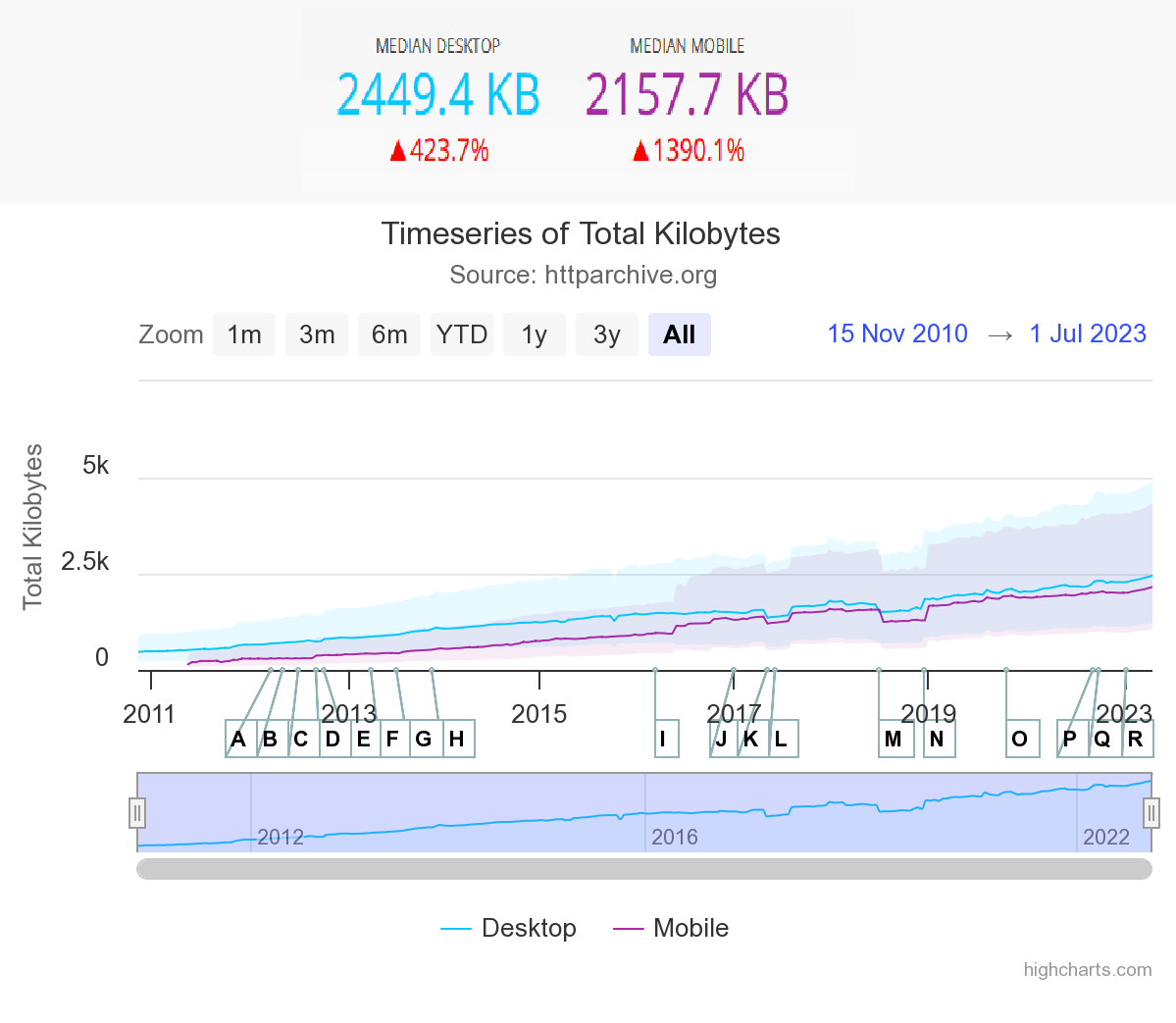
But it doesn’t have to be this way. We used to be better, back when we had to, and we can again. Growing communities like the 250kb Club, (which ramiels.me is a proud member of), are shining a spotlight on performant, efficient and accessible websites. Even Cloudflare and WordPress are introducing tools that automatically minify JS and compress images!
However, the sad reality is that these efforts are mere drops in the data ocean. The tech industry, frontend and back, needs a more conscientious approach. Our digital infrastructure is evolving, but so too must our understanding and application of it. Next time you’re stuck waiting for a page to load or a too-big download, remember: sometimes less is more.